
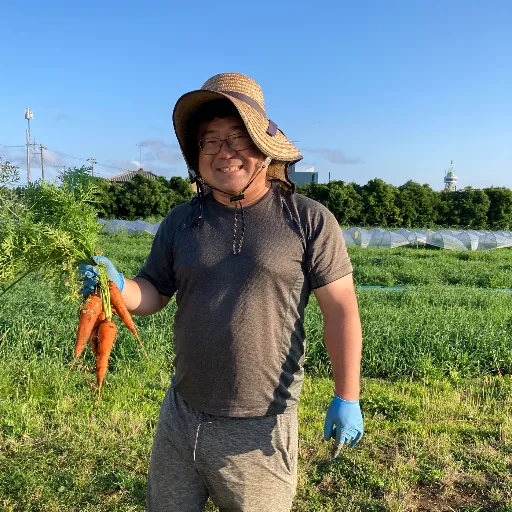
Experience farm work+harvesting in an environmentally regenerative agricultural field!
- PRICE
- Adult from ¥2,330
- AREA
- Sammu, Chiba, Japan
The Sammu-Yachimata area of Chiba Prefecture, where we have fields, is an area where field cultivation has flourished since ancient times, where volcanic ash plateaus spread out. This well-drained and windy land is suitable for growing vegetables, and neighboring Yachimata produces the most peanuts in Japan. Chiba Prefecture as a whole produces over 80% of the nation's peanuts. In one corner of such land, we are working on “environmentally regenerative agriculture,” where soil is grown little by little while returning grass and green manure to the soil without using pesticides as much as possible. When I dig a field, earthworms come out, and honeybees fly to the flowers. On the day of the event, I will guide you while walking through the fields.
This experience is a 2.5-3 hour program where you work together on the farm work for the day, harvest the grown vegetables with your own hands, and take them home.
Have you ever done farm work? They touch the soil, get sweaty, and gnaw freshly harvested food on the spot. When I tried it, it felt better than I thought Since it is a field that does not use pesticides, there are many unusual tasks that cannot be seen at ordinary tourist farms. Even first-time users are fine. I'll talk about what I'm doing now and why I'm doing this.
・What kind of environment do vegetables lined up in supermarkets grow ・Why are we working on environmentally regenerative agriculture ・What kind of ingenuity and hardships are there
You can feel things with your body in the actual field that you can't understand just by looking at the product. It is also recommended for those interested in food and agriculture, families who want their children to touch the soil and living things, and those thinking about starting a new farm.
◾️ THINGS TO DO IN THE FIELD ・Planting seedlings ・Harvesting, bagging, and preparation for shipment ・Spray the field with “mint water” made from spearmint in the evening ・The work of crushing cut grass on the spot and returning it to the soil ・Multi peeling It changes depending on the day, etc.
Before explaining, I think you'll be able to understand with your body, “Are fields that don't use pesticides like this?”
◾️ Today's flow (2.5 to 3 hours) ① Meeting and going around the field (15 minutes) *Detailed meeting locations will be announced in a message after making a reservation. Please also let us know the means of arrival (train/car). ② Field work together (1-1.5 hours) ③ Move to the harvesting field (10 minutes) *There may be movement depending on the situation on the day ④ Harvest experience (45 minutes to 1 hour) ⑤ Retrospective and dissolution (15 minutes)
◾️ Things you can do without pesticides This field does not use pesticides, so you can enjoy even the parts you would normally throw away. Daikon radish and carrot leaves can also be used in cooking as they are. Try nibbling on freshly harvested vegetables on the spot. I am often surprised to hear, “Leaves are so delicious.” If there are vegetables you like, they also sell them directly on the spot.
◾️ Can also run agricultural machinery Adults can actually operate agricultural machinery such as hammer knife mowers if they wish. “So much fun!” It is often said. Honestly, I enjoy it the most. Please consult with your child individually for safety when operating the machine. Manual work and harvesting are fine for children.
◾️ Group participation is also Welcomed We also accept groups such as students, corporate training, and local groups. The number of people, schedule, and details will be discussed, so please feel free to leave a message first. *You can take home the harvested vegetables as they are. *What can be harvested on that day changes with the season (see the annual production calendar). *The content may change depending on the weather and crop growth conditions. *If you have any questions, please contact us from “Send a message to the producer” on the experience details page.
・Clothes that are easy to move around in and can get dirty (long sleeve pants are recommended) ・Rain boots ・Drinks ・Work gloves ・Water (for washing vegetables on the spot)
- Japanese
- Native
- English
- Fluent
English (basic words and phrases)/Indonesian and Spanish (simple words only) ※The translation app will be used together for detailed communication. Overseas visitors are also welcome.
おひさま農園
〒289-1223 千葉県山武市埴谷
- Parking
- Available
If you cancel after your booking is confirmed, the following cancellation fees apply.
| 7 or more days before | No cancellation fee |
| 2–6 days before | 30% of the price |
| 1 days before | 50% of the price |
| Same-day cancellation / No-show | 100% of the price |
| Bad weather / farmer's circumstances | No cancellation fee |
Cancelled if rainy / full refund
If the weather is bad, we will contact you by message the day before.
Select your preferred date and time
Check availability and choose the date and time you'd like to join. Fully booked dates can't be selected.Enter participant and payment details (name, contact, number of people)
Enter your name, contact details, and number of participants to request a booking. No charge is made at this point.Farmer approval
The farmer reviews and approves your request. Once approved, payment and your booking are confirmed, and you'll receive a confirmation email. If not approved, the booking is automatically cancelled with no charge.Payment
Payment is charged to your registered payment method as soon as the farmer approves your booking.Join on the day
You'll receive a reminder email the day before. On the day, check the meeting point and what to bring on your booking page, then meet the farmer in person.Leave a review
After the experience, you can post a review. Following a farmer you'd like to support lets you know about new experiences, and you can also send support (a tip) directly.
Helpful articles
Recommended article
はじめての方へ:登録から予約完了までの流れ
noumeeでの登録から体験予約が確定するまでの流れを、実際の画面とあわせて丁寧に紹介します。支払いのタイミングや無料キャンセルの条件など、初めてでも安心して予約できるポイントも解説します。
Recommended article
農業体験の持ち物と服装ガイド
初めての農業体験で迷いがちな服装と持ち物の選び方を紹介します。汚れてもいい服・歩きやすい靴・季節ごとの注意点に加え、収穫物の持ち帰り方まで、参加前に確認しておきたいポイントをまとめました。
Recommended article
生産者とつながる3つの方法(買う・行く・送る)
生産者さんを応援したいときにできる3つの方法を紹介します。直売所での購入、農業体験への参加、そしてnoumeeの応援機能でメッセージと金額を直接届ける方法です。
Recommended article
有機栽培・自然栽培・環境再生型の違いとは?農業体験前に知りたい基礎知識
有機栽培・自然栽培・環境再生型農業、それぞれの違いと考え方を解説します。農業体験に行く前に読むと、生産者さんとの会話がもっと面白くなります。